You NEED to Know These 10 Christmas Songs in 2025
You NEED to Know These 10 Christmas Songs in 2025
Hey guys, Brad Litton from SimpleGuitar.com. This is the write-up of my YouTube lesson on 10 Christmas songs using only five chords so you can be ready for the parties.
Grab the PDF of all 10 songs (rhythm sheets, no page turns): simpleguitar.com/lastminutechristmas
The Five Chords
You only need G, C, E minor, D, and A minor. Standard open versions are fine. Here's how I like to play them.
G add5 (nickname): third finger on the third fret of the second string, pinky on the third fret of the first string. (Standard G is third fret first string, second fret fifth string, third fret sixth string.) "Add5" isn't a real chord type — it just tells us which G. You can use this anytime you see a G.
Cadd9: leave those third and fourth fingers down. Move first and second over a string: second finger third fret fifth string, first finger second fret fourth string, third string open. Easiest change in the world from G to C — just two finger...
How to Play Joy to the World on Guitar (The Easiest Christmas Song)
How to Play Joy to the World on Guitar (The Easiest Christmas Song)
Hey guys, Brad Litton from SimpleGuitar.com. This is the write-up of my YouTube lesson on the easiest Christmas song to get down last-minute: Joy to the World. I'll show you the melody (one note at a time) and a simple three-chord strum so people can sing along.
Grab the music first so you can follow along: simpleguitar.com/joytotheworld
The Melody
The melody is really simple. We're only playing your first three strings, and we're using your first three fingers.
The rule: use the same finger as whatever fret you're playing.
- First fret → first finger (any of those three strings)
- Second fret → second finger
- Third fret → third finger
- Plus open strings
I play through the whole melody on the video. If you need to rewind, slow it down, and play along, do it. Repeat any parts you need. The tab in the download has the melody written out.
The Chords You Need
Just three: G, C, and D. This is the simplest versi...
How to Play Silent Night on Guitar (4 Levels)
How to Play Silent Night on Guitar (4 Levels)
Hey guys, Brad Litton from SimpleGuitar.com. This is the write-up of my YouTube lesson on Silent Night — from total beginner melody all the way up to a full guitar arrangement where you play the melody and the chords at the same time.
I think Silent Night is one of the most essential Christmas songs to know as a guitar player, because it was originally written for the guitar. I end up playing this every Christmas season.
Grab the tab for all four levels: simpleguitar.com/silentnight
This song is in 3/4 time — three beats per measure.
Level 1: Just the Melody
One note at a time. Super straightforward.
Start with the third fret on your second string. I like my second finger there, because we only play the first fret at the very end of the song.
First phrase (repeats twice): third fret second string, open high E (first string), open first string, open second string.
Then come up to the fifth fret on your first string, down to two, ...
The Slash Chord Trick Pros Use (Most Players Miss This)
The Slash Chord Trick Pros Use (Most Players Miss This)
Hey guys, Brad Litton from SimpleGuitar.com. This blog post transcribes my YouTube lesson on slash chords — chords over bass notes. Most players stay stuck on the same old open chords. Pros use this little slash (not that Slash) and it instantly makes progressions sound smoother and more expensive.
We actually spent time on this in the Guitar Mastery Circle. This is the condensed version so you can start using it today.
What Is a Slash Chord?
When you see something like G/B, that's not two chord names. That's one chord, and after the slash is the bass note you play with it.
- G/B = G over B. Play a G chord, but make sure the lowest note you hear is a B.
- D/F# = D over F#. Lowest note is F#.
- Am/G = A minor with a G in the bass.
Important: the bass note does not have to be part of the chord. In G/B, B is in the G chord. In G/F#, that F# is not in the G chord. We use that to keep the bassline moving, and that's what hooks...
5 Mistakes Adult Guitar Players Make (And How to Fix Them)
5 Mistakes Adult Guitar Players Make (And How to Fix Them)
Hey guys, Brad Litton from SimpleGuitar.com. This blog post transcribes my YouTube video on the five mistakes I see adult guitar players make over and over — the ones that keep people stuck for months, sometimes years.
I just hit 6 years on YouTube. After teaching thousands of adult players, these are the traps that show up again and again. The frustrating part is most of the time the person thinks the problem is them — that they're not talented enough, or they started too late. It's almost never that.
If you've been playing for a while and you still feel like a perpetual beginner, this one's for you.
Most of the people I work with are adults — 40s, 50s, 60s, 70s and beyond. Busy, jobs, families, a lot of them have tried and quit before. The adult brain learns differently than a kid's. We understand things faster, but we also get in our own way faster. These five mistakes are usually the reason.
Mistake 1: Trying to Hol...
How to Play Have You Ever Seen the Rain by CCR
How to Play Have You Ever Seen the Rain by Creedence Clearwater Revival
Hey guys, Brad Litton from SimpleGuitar.com. This is the write-up of my YouTube lesson on the rhythm guitar part to "Have You Ever Seen the Rain" by Creedence Clearwater Revival. We're going to break it down the way we always do: intro (including two optional little licks), verse, chorus, then the whole song from start to finish.
I put together a free rhythm sheet for this. Grab it first so you can follow along: simpleguitar.com/seentherain
Time Signature and Strumming
The rhythm sheet is in 4/4. Every time you see a chord name, that's how many beats you're playing that chord — four beats per measure.
The strum is just eighth notes: 1 and 2 and 3 and 4 and — down up down up down up down up. That's all you need.
Add accents on beat 2 and beat 4. In the intro (and a few other spots) you'll hear little 16th-note pickups — and-a 1 — that you can slip in as you hear them. You'll hear that first thing in the int...
How to Play Bad Moon Rising by Creedence Clearwater Revival
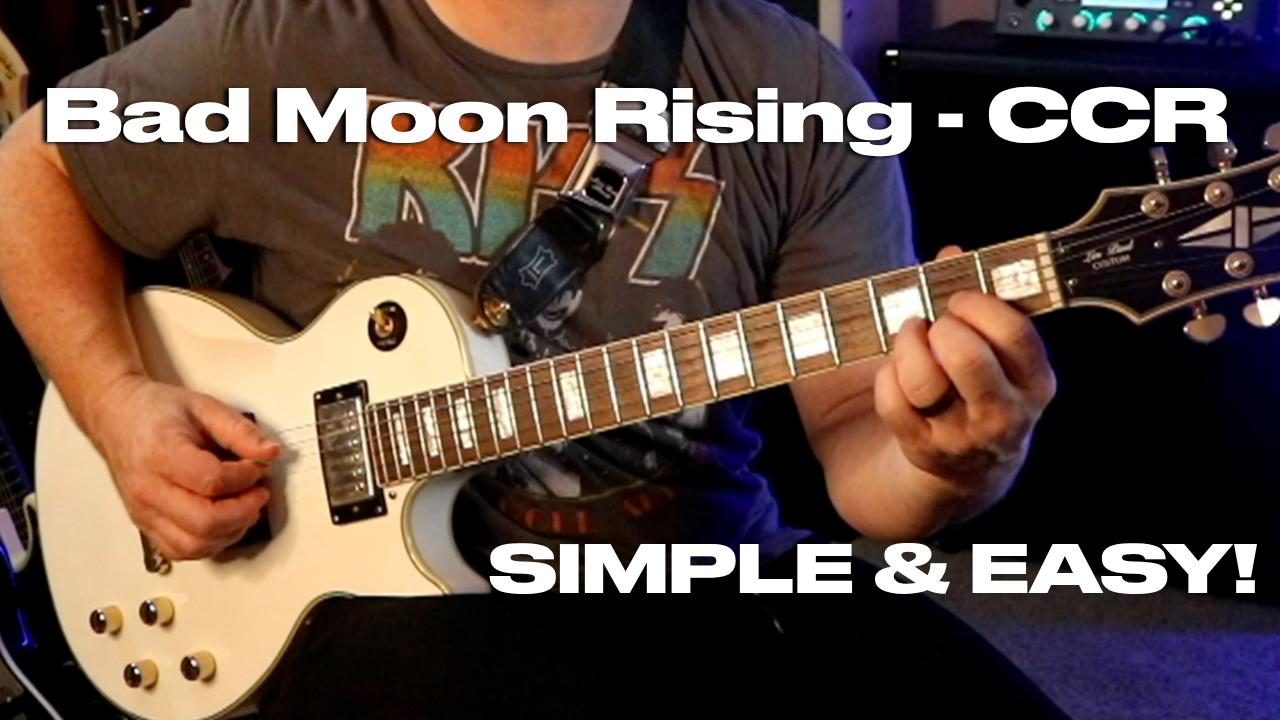
If you've been playing guitar for a while but feel like you never actually play enough songs, this lesson is for you. Today we're breaking down "Bad Moon Rising" by Creedence Clearwater Revival in a super simplified way. We're not going for note-for-note accuracy from the record — we're making it easy and fun so you can strum along and enjoy playing.
This version uses just three open chords: D, A, and G. The entire song revolves around two simple chord progressions (verse and chorus). Let's dive in!
The Three Chords You Need
- D chord (standard open position)
- A chord (standard open position)
- G chord (standard open position)
That's it — piece of cake!
Strumming Patterns (3 Options for Any Level)
1. Beginner-Friendly: The Boom-chuck Pick the lowest 1–2 strings of the chord (the "boom"), then strum the rest of the chord (the "chuck").
- On D: Pick strings 4 & 3
- On A: Pick strings 5 & 4
- On G: Pick strings 6 & 5
Play boom-chuck on beats 1-2 and again on 3-4. This keeps th...
How to Hold a Guitar Pick: Easy Beginner Guide
How to Hold a Guitar Pick: A Beginner's Guide
Learning to play the guitar is an exciting journey, and one of the first steps is mastering how to hold a guitar pick properly. A good grip ensures better control, cleaner strumming, and smoother playing—whether you're just starting out or refining your skills. In this blog post, we’ll break down the essentials of holding a guitar pick, perfect for beginners. (Check out our latest YouTube video for a visual guide!)
Why Holding a Pick Matters
The way you hold your guitar pick affects your sound and comfort. A proper grip helps you:
-
Play chords and notes clearly without buzzing.
-
Strum or pick with confidence and precision.
-
Avoid dropping the pick during practice or performance.
Let’s dive into the simple steps to get it right!
Step-by-Step: How to Hold a Guitar Pick
Follow these beginner-friendly steps to hold your pick like a pro:
1. Choose the Right Pick
Picks come in different shapes, sizes, and thicknesses. F...
Beginner Guitar Gold: 1 Finger Drop D Chords!
Beginner Guitar Lesson: Mastering Drop D Power Chords with 1 Finger
Welcome, beginner guitarists! In this blog post, we’ll break down the key lessons from my YouTube video on playing Drop D power chords using just one finger. This simple technique is perfect for new players looking to rock out with minimal effort. Let’s dive into tuning, the one-finger method, and 12 easy chords you can master fast!
Getting Started: Drop D Tuning
-
What is Drop D?: We’re changing your guitar’s low E string (the thickest one) to a D note.
-
How to Tune:
-
Grab a tuner—clip-on, pedal, or app works fine.
-
Pluck the low E string and adjust the tuning peg until it reads D.
-
Check it against your open D string (4th string) for reference—it should sound the same, just deeper.
-
-
Why Drop D?: It gives power chords a heavy, chunky sound, perfect for rock and metal!
The 1-Finger Power Chord Trick
-
What’s a Power Chord?: A simple chord, usually two or three notes, that sounds
...
Unlock Killer Guitar Vibrato: Step by Step for Beginners!
Unlock Killer Guitar Vibrato: Step-By-Step for Beginners!
Hey, guitar heroes! Welcome to this exciting lesson on guitar vibrato—a key technique to make your playing sound expressive and pro-level. This blog post transcribes my latest YouTube video (https://www.youtube.com/watch?v=IqblIRc8KI0) to guide you through what vibrato is, how to do it, and tips to practice it effectively. Let’s dive in and add some soul to your guitar playing!
Introduction: What is Guitar Vibrato?
-
Welcome!: Hey everyone, thanks for joining me in this beginner guitar lesson. Today, we’re tackling vibrato—an awesome technique to make your notes sing!
-
Definition: Vibrato is when you bend a note slightly up and down to add emotion, warmth, and personality to your playing. It’s like how a singer wobbles their voice—super cool for guitarists!
Step 1: Understanding the Basics
-
Why Vibrato?: It makes your notes sound alive—perfect for solos, melodies, or even simple riffs. Think blues, rock, or
...