How to Play Bad Moon Rising by Creedence Clearwater Revival
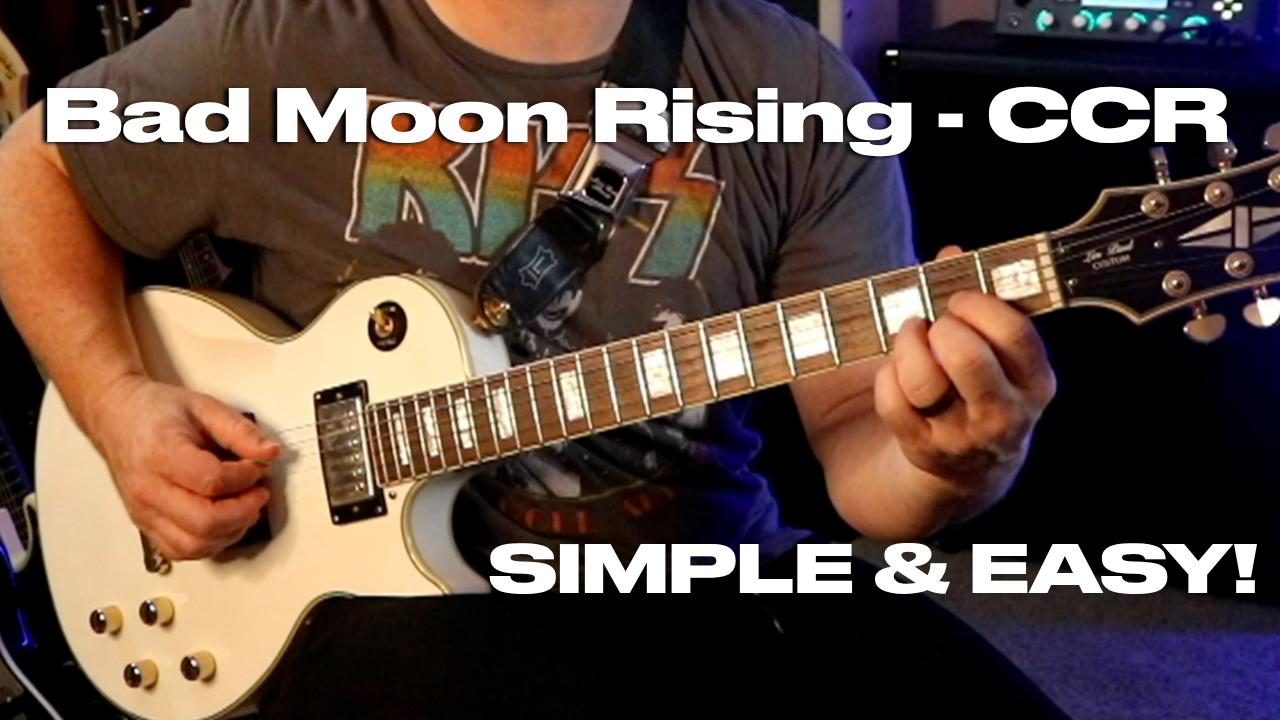
If you've been playing guitar for a while but feel like you never actually play enough songs, this lesson is for you. Today we're breaking down "Bad Moon Rising" by Creedence Clearwater Revival in a super simplified way. We're not going for note-for-note accuracy from the record — we're making it easy and fun so you can strum along and enjoy playing.
This version uses just three open chords: D, A, and G. The entire song revolves around two simple chord progressions (verse and chorus). Let's dive in!
The Three Chords You Need
- D chord (standard open position)
- A chord (standard open position)
- G chord (standard open position)
That's it — piece of cake!
Strumming Patterns (3 Options for Any Level)
1. Beginner-Friendly: The Boom-chuck Pick the lowest 1–2 strings of the chord (the "boom"), then strum the rest of the chord (the "chuck").
- On D: Pick strings 4 & 3
- On A: Pick strings 5 & 4
- On G: Pick strings 6 & 5
Play boom-chuck on beats 1-2 and again on 3-4. This keeps things steady and interesting while you're learning.
2. Next Level: Down Down Up Down Up Strum pattern: Down, down, down, up, down, up (repeat). Practice slowly: Down – down – down -- up – down – up | Down – down – down -- up – down – up
3. Main Groove Pattern (Recommended) Use the same base as above, but skip the downstroke on beat 3: Down, down, up, (skip), down, up → Counts as: 1 2 & 4 &
Important Tip: Swing the Rhythm! "Bad Moon Rising" has a laid-back, groovy feel. Don't play straight eighth notes. Instead, swing them: make the first note longer and the second shorter (long-short, long-short).
Practice this on a single G chord: Long – short – long – short – long – short – long…
This swing is what gives the song that classic CCR vibe.
Verse Chord Progression
The main progression (used for intro, verses, and solo sections):
- D (full measure)
- A (beats 1-2) + G (beats 3-4) → split measure
- D (full measure)
- D (full measure)
Repeat this block as needed.
When switching from A to G in the split measure, use the boom-chuck for clarity.
Slow example rhythm (with swing): 1 2 & 4 & (A/G split) → back to D
Chorus Chord Progression
- G (two full measures)
- D (two full measures)
- A (one measure)
- G (one measure)
- D (two full measures)
Overall chorus flow: G – D – A – G – D
Full Song Structure
Here's how the song is put together:
- Intro: Verse progression × 1
- Verse 1: Verse progression × 4
- Chorus: Chorus progression × 1
- Verse 2: Verse progression × 4
- Guitar Solo: Verse progression × 2 + Chorus progression × 1
- Verse 3: Verse progression × 4
- Final Chorus: Chorus progression × 2 (end on D)
Free Rhythm Sheet (Highly Recommended)
I've created a free downloadable rhythm sheet that makes this even easier. It includes:
- Chords clearly marked over the lyrics
- 4/4 time signature for every measure
- Split measures shown for the A-to-G change
- Exact placement so you always know where you are
→ Download the Free "Bad Moon Rising" Rhythm Sheet Here
The sheet uses a simple system: each chord name = one full measure (unless it's a split measure). This takes the guesswork out and helps you focus on strumming and singing along.
Final Practice Tips
- Start slow — the slower you play cleanly, the faster you'll learn.
- Record yourself or play along with the original song once you have the changes down.
- Focus on the swing feel from the beginning.
- Most importantly: play the full song all the way through, even if it's messy at first. That's how you improve!
This approach is perfect for adult guitar players who want to have fun and actually finish songs instead of getting stuck on exercises.
If you enjoyed this lesson, check out more easy song tutorials on the channel, or consider personalized coaching if you're ready to move past sloppy chord changes for good.
What song should I simplify next? Drop your requests in the comments!
About the Author Brad from Simple Guitar helps adult learners play the songs they love without the frustration. Visit simpleguitar.com for more free resources and lessons.